
Bitcoin has emerged as a prominent digital asset, attracting investors worldwide. However, the tax implications of Bitcoin investments can be complex and vary significantly across jurisdictions. This research paper delves into the strategies and legal avenues available to investors seeking to minimize or eliminate capital gains tax on their Bitcoin holdings in 2025 and beyond.
Countries with No Capital Gains Tax on Bitcoin
Several countries have adopted favourable tax policies for cryptocurrency, making them attractive destinations for investors seeking to minimize their tax burden. These countries generally do not impose capital gains tax on long-term cryptocurrency holdings, and some even extend this benefit to short-term gains. Here are some of the most prominent jurisdictions:
We go into details on each country below this table:
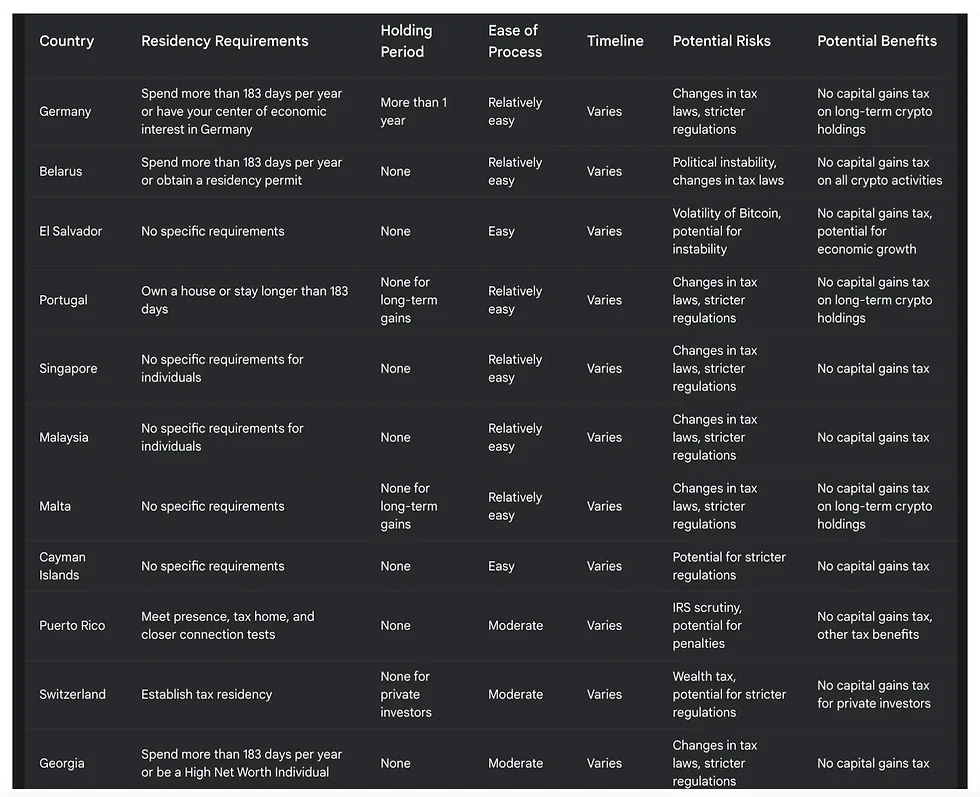
Portugal: Portugal was previously a haven for crypto investors, with all gains from selling crypto being tax-free since 2018 meaning there is a large community of people in crypto in Portugal 4. However, new guidance introduced in January 2023 changed things a little for short-term gains (crypto held for less than a year) which are now subject to a flat tax rate of 28%, while long-term gains remain tax-free 2. Longer holdings than a year have 0% capital gains still. Crypto-to-crypto trades also remain tax-free making Portugal still a fantastic place for anyone in crypto and looking to build a life around community 2.
Germany: Germany treats Bitcoin and other cryptocurrencies as “private money” rather than capital assets1. This means that if you hold your crypto for more than one year, you generally won’t pay any tax when you sell, swap, or spend it. However, it’s important to note that Germany still subjects some crypto activities to income tax, such as receiving payment in crypto, mining crypto, and staking crypto1.
Belarus: Belarus has taken a unique approach by legalizing all crypto-related activities and exempting individuals and businesses from crypto taxes until at least 20252. This includes activities like mining and day trading, which are typically taxed in other countries2. However, it’s important to consider the potential risks associated with Belarus’s political environment, as it is often referred to as “Europe’s last dictatorship.” 3 If you’re considering Belarus, it’s crucial to weigh the tax benefits against the potential political and economic instability.
El Salvador: El Salvador made headlines as the first country to make Bitcoin legal tender4. Initially, this meant that businesses were required to accept Bitcoin, and taxes could be paid in Bitcoin5. However, the International Monetary Fund (IMF) has urged El Salvador to cease using Bitcoin as legal tender, citing concerns about financial stability and consumer protection6. In response, the government has agreed to slow down its adoption, and Bitcoin is no longer accepted for tax payments7. Businesses are also no longer required to accept it as legal tender7.
Singapore: Singapore has positioned itself as a hub for cryptocurrency businesses and investors due to its lack of capital gains tax4. Individuals and businesses do not pay taxes on gains from selling or trading crypto4. However, companies whose primary business activity involves cryptocurrency trading must pay income tax on their profits4. It’s also worth noting that using Bitcoin to pay for goods and services in Singapore is considered a barter trade and not subject to Goods and Services Tax (GST)2.
Malaysia: Similar to Singapore, Malaysia currently does not have a capital gains tax, making crypto transactions tax-free for individual investors4. However, the Malaysian Inland Revenue Board has indicated that frequent and repetitive crypto trading may be considered a business activity and subject to income tax4. Additionally, there are indications that Malaysia may introduce a capital gains tax in the future8. Businesses operating in the cryptocurrency space in Malaysia must register with the Securities Commission Malaysia and comply with other regulations9.
Malta: Malta, often referred to as “Blockchain Island,” has a favorable tax regime for cryptocurrency investors4. Long-term crypto investments are generally exempt from capital gains tax4. However, if transactions are carried out within the same day, the gains may be taxed as income4. It’s important to be aware that Malta has been strengthening its regulations on cryptocurrency, which could make it a less attractive option for some investors in the future10.
Cayman Islands: The Cayman Islands is a well-known tax haven, and this extends to cryptocurrency as well4. There are no capital gains taxes on crypto, making it an attractive option for investors4. However, with the increasing popularity of cryptocurrencies, there is a potential for increased scrutiny from tax authorities in the future11.
Puerto Rico: Under Act 60, Puerto Rico offers significant tax incentives for individuals and businesses, including a 0% tax rate on capital gains from crypto, interest, and dividends12. However, to qualify, individuals must meet specific requirements, such as relocating to Puerto Rico and establishing bona fide residency12. This involves passing three tests: the presence test, the tax home test, and the closer connection test13.
Switzerland: Switzerland has a reputation for being crypto-friendly14 with no capital gains tax on crypto for private investors4. However, cryptocurrencies are subject to an annual wealth tax, which is levied on the total value of your assets, including crypto4. It’s also important to note that Switzerland may introduce stricter regulations on cryptocurrencies in the future15.
Georgia: Georgia is another country with no capital gains tax on Bitcoin4. The Georgian Ministry of Finance has clarified that individuals are exempt from income tax on profits from selling cryptocurrency4. To qualify for tax residency in Georgia, individuals can either spend more than 183 days per year in the country or obtain a High Net Worth Individual tax residency16. The latter requires meeting specific criteria, such as having a proven wealth of GEL 3,000,000 (approximately EUR 970,000) or an annual income of more than GEL 200,000 (EUR 72,000) during the previous three years16.
Regulations and Requirements
Each country has specific regulations and requirements for realizing the tax benefits on Bitcoin. These may include:
Residency Requirements
Most countries require individuals to establish tax residency to benefit from the tax exemptions. This typically involves spending a minimum number of days in the country per year or meeting other criteria, such as having your center of economic interest in the jurisdiction17. For example, to obtain a tax residence certificate in Monaco, you must demonstrate that you have a place to live in Monaco, meet the tax residency criteria (either spending more than 183 days per year in Monaco or having your center of economic interest there), and provide evidence of occupying a residence in Monaco over the past year18.
Holding Period
Some countries, like Germany, have a holding period requirement for cryptocurrencies to be exempt from capital gains tax. This means you need to hold the crypto for a certain period, usually one year, before selling it to avoid taxes1.
Reporting Requirements
Even in countries with no capital gains tax, it’s essential to maintain accurate records of all crypto transactions and report them to the relevant tax authorities. This ensures compliance with tax laws and helps avoid potential penalties19.
Process and Timeline
The process and timeline for realizing tax benefits on Bitcoin can vary significantly across countries. Some jurisdictions have streamlined procedures that can be completed within a few months, while others may require more time and documentation. For example, obtaining tax residency in Monaco may involve a multi-step process that includes obtaining a visa, applying for a temporary residence permit, and eventually securing a tax residence certificate4. The specific requirements and timelines should be carefully reviewed for each country.
Ease of the Process
The ease of realizing tax benefits on Bitcoin varies across countries. Some jurisdictions have straightforward processes with minimal requirements, while others have more complex procedures and stricter regulations. For example, establishing tax residency in Monaco may involve demonstrating financial sufficiency and securing a tax residence certificate18. In contrast, countries like El Salvador and Belarus have more relaxed requirements3.
Tax Optimization Strategies
In addition to relocating to a tax-friendly jurisdiction, investors can employ various tax optimization strategies to minimize their capital gains tax burden on Bitcoin. These strategies can be applied in any country and may provide significant tax benefits. Here are a few examples:
Holding for the Long Term: In many countries, including the United States, long-term capital gains tax rates are lower than short-term rates. By holding your Bitcoin for more than one year before selling, you can potentially reduce your tax liability20.
Tax-Loss Harvesting: This strategy involves selling Bitcoin at a loss to offset capital gains from other investments. By realizing losses, you can reduce your overall tax burden21.
Donating to Charities: Donating appreciated Bitcoin to qualified charities can be a tax-efficient way to support causes you believe in while minimizing your tax liability. In many jurisdictions, these donations are not only tax-deductible but also exempt from capital gains tax21.
The Evolving Regulatory Landscape
The regulatory landscape for cryptocurrencies is constantly evolving, and it’s crucial for investors to stay informed about potential changes that could impact their tax obligations. Governments worldwide are increasingly focusing on regulating and taxing cryptocurrencies, and new policies could affect the tax benefits currently enjoyed by investors22. Factors such as political instability, economic shifts, and international tax agreements can all influence a country’s crypto tax laws23.
For example, the Organisation for Economic Co-operation and Development (OECD) has been working on a framework for the taxation of cryptocurrencies, which could lead to greater harmonization of tax rules across different countries23. This could potentially impact the tax benefits currently available in certain jurisdictions.
Risks and Benefits
Each option for minimizing capital gains tax on Bitcoin comes with its own set of risks and benefits. Relocating to a new country may involve significant costs and lifestyle changes, while taking advantage of tax loopholes could carry the risk of future audits and penalties24. For example, relocating to El Salvador may provide tax benefits, but it also exposes investors to the volatility of Bitcoin and the potential for economic instability in the country6. It’s essential to carefully weigh the potential risks and benefits before making a decision.
Conclusion
Legally minimizing or eliminating capital gains tax on Bitcoin requires careful planning and consideration of various factors, including residency requirements, holding periods, potential geopolitical risks, and tax optimization strategies. Investors should thoroughly research the tax laws in different jurisdictions and seek professional advice to make informed decisions that align with their individual circumstances and investment goals. Consulting with a tax advisor who specializes in cryptocurrency can provide personalized guidance and help you navigate the complexities of crypto taxation.
If you’re looking for the perfect tax set-up you can use our free tool that’s coming soon that recommends the top three places for your tax, lifestyle and finances.
Learn more at www.thebitcoinvisa.com
Works Cited
1. Immigrate to Monaco and apply for Residence Permit | Residencies.IO, accessed on February 5, 2025, https://residencies.io/residency/monaco/temporary-residency/mc1
2. Crypto Tax Free Countries 2025 — Koinly, accessed on February 5, 2025, https://koinly.io/blog/crypto-tax-free-countries/
3. Move to This Country to Avoid Cryptocurrency Taxes | Gordon Law Group, accessed on February 5, 2025, https://gordonlaw.com/learn/countries-no-crypto-tax/
4. Monaco Residence by Investment — Henley & Partners, accessed on February 5, 2025, https://www.henleyglobal.com/residence-investment/monaco
5. El Salvador’s Bitcoin Law: Contemporary Implications of Forced Tender Legislation, accessed on February 5, 2025, https://legaljournal.princeton.edu/el-salvadors-bitcoin-law-contemporary-implications-of-forced-tender-legislation/
6. Bitcoin in El Salvador — Wikipedia, accessed on February 5, 2025, https://en.wikipedia.org/wiki/Bitcoin_in_El_Salvador
7. Bukele’s crypto autocracy in El Salvador gains Trump’s nod of approval — People’s World, accessed on February 5, 2025, https://www.peoplesworld.org/article/bukeles-crypto-autocracy-in-el-salvador-gains-trumps-nod-of-approval/
8. TheWall: Profited from trading bitcoin? Find out if you need to pay taxes — The Edge Malaysia, accessed on February 5, 2025, https://theedgemalaysia.com/article/thewall-profited-trading-bitcoin-find-out-if-you-need-pay-taxes
9. Guidelines on the Tax Treatment of Digital Currency Transactions | EY Malaysia, accessed on February 5, 2025, https://www.ey.com/en_my/technical/tax-alerts/guidelines-on-the-tax-treatment-of-digital-currency-transactions
10. Cryptocurrency Regulations in Malta — Sanction Scanner, accessed on February 5, 2025, https://www.sanctionscanner.com/blog/cryptocurrency-regulations-in-malta-796
11. Cayman Islands blockchain and cryptocurrency regulation 2020, second edition — Carey Olsen, accessed on February 5, 2025, https://www.careyolsen.com/sites/default/files/CO_CAY_Blockchain-and-Cryptocurrency-Regulation-2020-2nd-Edition.pdf
12. Monaco Residency Minimum Stay (2025 Requirements), accessed on February 5, 2025, https://www.relocateandsave.com/monaco-residency-minimum-stay/
13. Puerto Rico Crypto Tax Guide 2025 — Koinly, accessed on February 5, 2025, https://koinly.io/guides/crypto-tax-puerto-rico/
14. Crypto Tax Switzerland: 2025 Guide — Koinly, accessed on February 5, 2025, https://koinly.io/guides/switzerland-crypto-tax-guide/
15. Cryptocurrencies for individuals | RSM Switzerland, accessed on February 5, 2025, https://www.rsm.global/switzerland/en/service/tax-legal-services/cryptocurrencies-taxation/cryptocurrencies-for-individuals
16. Cryptocurrency and TAX FREE Trading — PB Services Georgia, accessed on February 5, 2025, https://pbservices.ge/blog/georgia-for-cryptocurrency-and-other-assets-trading/
17. How to apply for a residence certificate for tax purposes — MonServicePublic.mc, accessed on February 5, 2025, https://monservicepublic.gouv.mc/en/themes/nationality-and-residency/residency/residents/how-to-apply-for-a-residence-certificate-for-tax-purposes
18. What Is The Personal Income Tax In Monaco? (2025 GUIDE), accessed on February 5, 2025, https://www.relocateandsave.com/monaco-personal-income-tax/
19. Crypto Taxes in Switzerland 2025: The Ultimate Guide — Blockpit, accessed on February 5, 2025, https://www.blockpit.io/tax-guides/crypto-tax-guide-switzerland
20. Cryptocurrencies and Taxes: What You Should Know | Charles Schwab, accessed on February 5, 2025, https://www.schwab.com/learn/story/cryptocurrencies-and-taxes-what-you-should-know
21. How to Avoid Crypto Taxes: 12 White Hat Strategies to Lower Your Bill, accessed on February 5, 2025, https://gordonlaw.com/learn/avoid-crypto-taxes/
22. Top 10 geopolitical risks in 2025 Geostrategic Outlook | EY — Global, accessed on February 5, 2025, https://www.ey.com/en_gl/insights/geostrategy/2025-geostrategic-outlook
23. Actionable global tax insights for 2024 — Baker Tilly, accessed on February 5, 2025, https://www.bakertilly.com/insights/tax-strategy-playbook-global-tax-2024
24. Crypto Poses Significant Tax Problems — and They Could Get Worse, accessed on February 5, 2025, https://www.imf.org/en/Blogs/Articles/2023/07/05/crypto-poses-significant-tax-problems-and-they-could-get-worse